B TEAMRACE WARS 1953:The Legend of the Three Little Pepperell Diesels
B TEAMRACE WARS 1953:The Legend of the Three Little Pepperell Diesels
In the beginning
In the early 1950’s, the Eta 29 was making an impact in B team-race and their 30-year reign was just starting. Eta’s were becoming one of the popular choices for T/R models, in Australia and New Zealand, no less in the United Kingdom where the Son of an ex-patriot New Zealander, Ken Bedford manufactured them. Ira and Vern Pepperell had been manufacturing quite advanced model aircraft engines since 1936 in New Zealand and their model spark, glow plug and diesel engines were very well known.
According to Maurice Poletti, in his book in 2003, “Those Incredible Pepperell’s”, the legend is that someone was talking to the Pepperell’s about engines, and expressed the opinion that no diesel would ever beat the Eta 29 in a team race. Red Rag to a Bull. Vern Pepperell regarded this as a challenge he could not pass up. He proceeded to design and make a team race diesel that could, and when tested against the ETA would beat it.
Even today with significant advantages in diesel engine technology, it seems a very wild idea that a local build New Zealand diesel engine would beat an Eta 29 in a B race in 1953. When introduced, the Mk I Eta 29 was quoted as delivering 0.54 bhp @ 14000 rpm. (Reference 2 below) Nothing like the performance of the Eta 6C producing 0.82 bhp @ 17000 rpm but still a formidable foe at the time all the same.
The new design
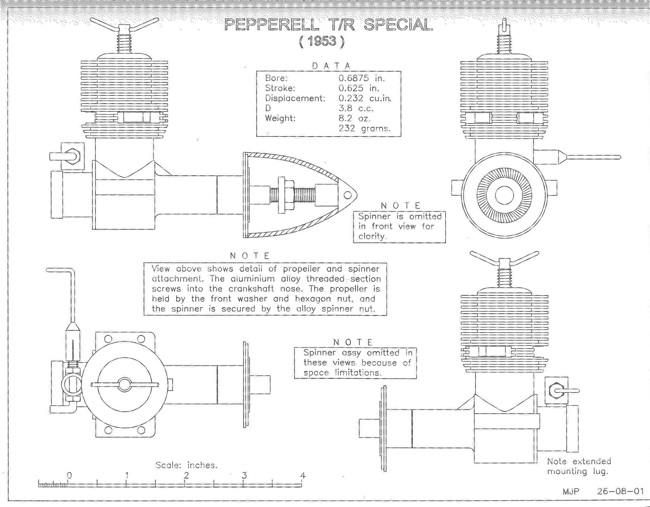
Vern set to work in his meagre factory workshop attached to his home to design the “Eta beater”. The displacement chosen by Vern was 0.232cu.in, smaller than the 29 of the Eta but in line with some of his existing engine sizes.
The initial prototype engine used disc rotary induction like the Eta, but with considerable foresight, this was eventually rejected in favour the more advanced and less complicated drum rotary induction in the three or four twin ball-race engines that were eventually made. Considerable effort went into redesigning the port timing and design of the new engine, with the aim of decreasing fuel consumption and increasing power and reliability. (See more details in reference 1 below).
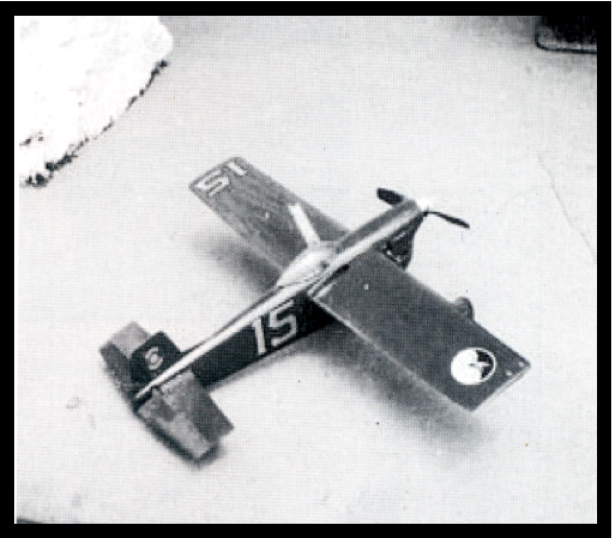
This resulted in a very unconventional arrangement but the new Pepperell diesel proved to be a winner. Ira designed a new racer for his engine and the plan of this model is included below.
Des Brain remarked, “the Pep diesel not only had lower fuel consumption than the Eta 29s, but it was as fast, perhaps even faster”.
The Racer
The drawing above shows the outline of the original 23D racer
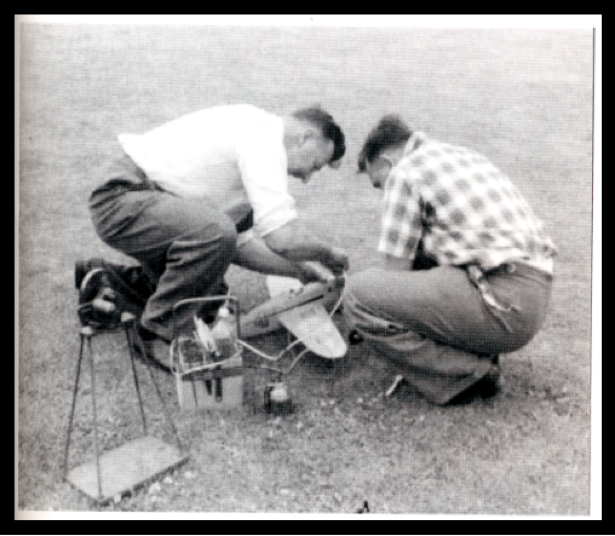
Top: the Pepperells in Hamilton, date unknown with a Double-Dice style model and
bottom: the Pepperell Racer as copied and build by Arthur Pearce for an inverted Torpedo 29 glow engine.
The big race
The success of the Pepperell model/motor combination can be judged from this report on the Waikato Championships taken from the Auckland model aero club Newsletter for August 1953:
The class B final was the highlight of the meeting. It was won very decisively by Ira Pepperell with Mr Vern Pepperell's model flown by Des Brain finishing a close second. The time taken to complete this race was only a little over 11 minutes, which is excellent when one considers that Vern Pepperell did the job of starting both motors in their planes.
It was interesting to note that the plane that won was the last off the ground by several laps. Full marks must go to Ira for his capable handling of his team racer - when he slipped on the wet ground on one of his take offs and after regaining his balance and changing the handle three times around the other pilots, gained control to carry on to an easy victory, It was interesting to note that of the four planes in the final, three were powered with a new type of diesel motor. "
Ira Pepperell was the pilot of his own model. Des Brain flew Vern's model, but the names of the other two pilots in the race, and their ground crew have been forever lost in time.
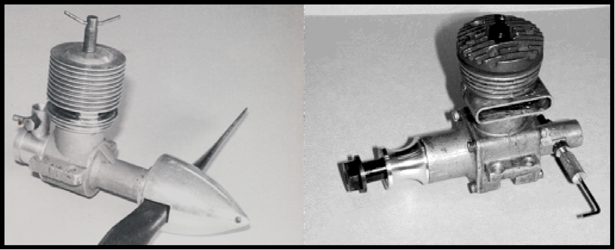
So, on its first outing the Pepperell 23 scorched the Eta’s quite convincingly, getting the first 3 places in a 4-up final. The engine design was completely revolutionary for its time, a drum induction twin ball bearing diesel with special porting, close spaced finning and integral front spinner. It was at least as fast as the Eta’s, maybe faster but far more fuel efficient like a diesel should be.
This little engine set the standards for many diesel team-race engines to come; in fact, it set the pattern for the much later drum induction engine that dominate F2C.
THE ENGINE: THE PEPPERELL 23 TEAM RACE SPECIAL
Lucky for us, two of the three legendary engines still exist today, held by control line aficionado’s and drawing and data have been taken from these examples with their very kind co-operation. The fate of the third engine, owned briefly by Bruce Keegan, is unknown.
All photo’s and drawing with kind permission of the Maurie Poletti, see reference 1. Below.
References:
1.Those Incredible Pepperell’s Maurice Poletti, 2003 W J Deed Printing Ltd, Waiuku, New Zealand. Pages 122-123, 132-133, 141.
2.http://modelenginenews.org/cardfile/eta29.html (Eta 29 Models and Marks) details on Eta 29 Mk II specification and output)
3.For copies of the book, Those Incredible Pepperell’s, contact
Maurie Poletti ("Maurie.Poletti" Maurie.Poletti@xtra.co.nz)
69 Willis Road
Papakura
New Zealand
Phone +64 9 298 9797